Bike review
Yamaha R15 V4 review: still the chassis to beat
A fortnight of mixed use — half at a race track, half in Bengaluru traffic — is the R15 owner’s reference case, and on paper the 155cc class benchmark rewards it. The frame is the story; the ergonomics are the bill.
- Yamaha R15 ₹1.55L
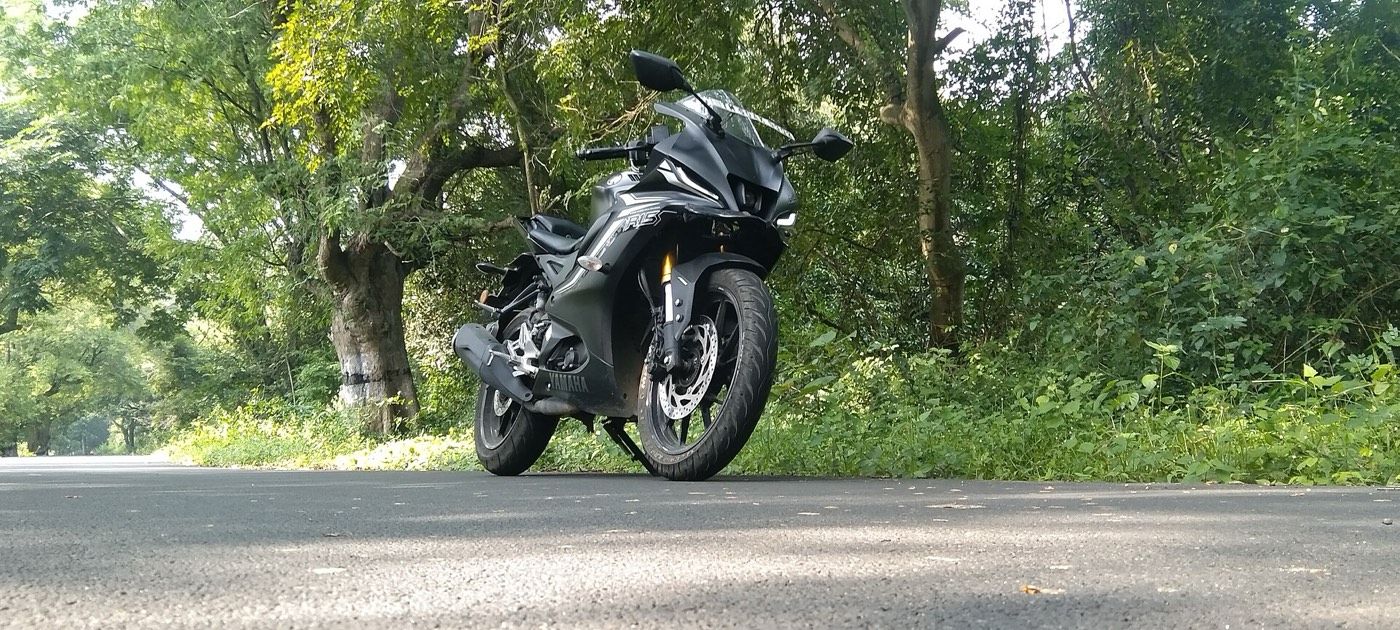
MotoSutra editorial rating
4.4/5
Verdict
Buy the R15 M at ₹1.68 lakh if you ride with any intent at all, because the quickshifter and traction control are the two things that separate this from a good bike. Anyone who mostly rides in traffic with a passenger should test the ergonomics before signing.
MotoSutra has not physically tested this vehicle. This review is research-based editorial analysis of the documented specification and published material; the score is a MotoSutra editorial rating. Read how we review.
There is a specific moment that explains why the R15 has outsold every other 155cc in this country for years. You are 40 km/h into a right-hand sweeper on a road you have ridden a hundred times, you are already on the gas when you realise you entered it 10 km/h too fast, and the bike simply holds the line. No crash, no wobble, no sense that the front end is negotiating with you. That is the Yamaha’s standing reputation, and at 155cc it remains the chassis to beat.
MotoSutra has not ridden the R15 or been on a track with it; what follows is a research-based reading of the documented specification against that reputation. The obvious reference programme for a bike like this — the R15 M especially — is a split fortnight, half at a race track, half in Bengaluru’s worst traffic, because that is how most owners use it, whether they admit it or not.
The engine: a peak, not a curve
The 155cc variable-valve single makes 18.4 bhp at 10,000 rpm and 14.2 Nm at 7,500. Those numbers describe an engine that has to be worked, and Yamaha has not disguised it. The curve reads as a modest commuter unit below 5,000 rpm — with the slightly clattery idle characteristic of a small single — pulling with real intent between 6,000 and 8,500, and revving to a hard, buzzy edge above 9,000 that sounds faster than the peak figure suggests. The VVA switch-over around 7,400 rpm is documented as a change in note rather than a shove.
At a race track that top-end behaviour would read as character rather than a limitation — an engine that sits in its power band and stays there, with a six-speed box of short, positive ratios to keep it on the boil. The quickshifter is the star of the electronics package: Yamaha lists clutchless upshifts from mid-rev, around 6,500 rpm upward, which means it should work through an entire city gearstack rather than only at the redline where a lesser system operates. Downshifts still need the clutch, and the assist-and-slipper arrangement is there to keep the rear from stepping out on a late brake-and-blip.
On the road, the same engine is a compromise. In sixth at 60 km/h the gearing makes it docile; overtaking a bus means dropping into fourth and revving it, which is fine on an open road and awkward in a gap between two vehicles in traffic.
City use: the part of the review that hurts
The R15 is the heaviest thing about it: 142 kg kerb, and that weight sits behind a fairly tall bar, so low-speed handling reads on paper as more stable than nimble. A light clutch and a wide friction zone, which Yamaha specifies, make queue work easy. What looks tiring is everything else. The pegs are high enough to sit close to a pillion’s heels, and the forward-set position means a loaded mid-corner speed breaker will bring the peg tip down sooner than a commuter’s would. The rear monoshock is set for track flatness, so a sharp perpendicular break looks likely to send a knock up through the split seat — how long before that registers in the tailbone is a question only a ride can settle.
Riding solo at 50 km/h with the fairing and the low bar, the posture looks committed in the way that makes riders smile and passengers complain. The seat height is 815 mm and the reach to the bar asks something of the wrists; MotoSutra reads a long run as tiring the wrists and right forearm first, not the back.
Refinement, brakes and the electronics
The chassis is where the money went, and on paper it is specified to avoid what cheaper 155cc bikes do: it is braced against the mid-corner wobble, the two-level traction control is there to intervene gently and early enough to be educational rather than frightening when the rear wheel finds a greasy patch, and the rigid frame and upside-down fork are the case against flex reaching the bar on kerb strikes. Whether it actually holds a line under hard braking from 110 km/h is a road-test question, but the 282 mm front disc and dual-channel ABS are a strong set of premises; MotoSutra expects modulation that is adequate rather than brilliant, with the first third of the lever travel doing less work than a rider would like.
Vibration is the one genuine refinement complaint on a small single. Between 6,500 and 8,000 rpm a buzzy residue through the footpeg and the bar is characteristic of the layout revving hard. It should be absent at a 60 km/h cruise, which is why MotoSutra expects cruising comfort to read far better than the tacho suggests it should. Wind noise above 100 km/h becomes the loudest thing in your ears, and the fairing is shaped to deflect the blast so that helmet noise rather than wind dominates.
Efficiency: the number nobody believes
Claimed mileage is 42 kmpl. MotoSutra estimates a realistic mixed-use band of 38-45 kmpl: the low 40s are reachable on a commute with the revs kept under 6,000, while a hard-used or track day — paddock idling and top-of-the-tacho runs included — would pull the figure toward the low 30s. On the 14.2-litre tank, that means a working range comfortably past 400 km between fills for most riders, and the honest number for any given owner depends on how they ride it.
Instruments, equipment and the small stuff
The negative-LCD console is legible and dense — digital tacho bar, shift-timing indicator, gear position, lap timer on the M — and this display type is the kind that reads well in direct sun, more than can be said for some TFT screens at twice the money. Bluetooth pairing is fitted and incoming calls display on the console, though the Yamaha app has a reputation for being slow and the connection prompt at every ignition is a known irritation. LED lighting front and rear, and Yamaha bills the headlamp beam pattern as a genuine improvement over the last generation for unlit roads.
Storage is nil, which is a fair trade on a sports bike, and the under-seat space fits nothing larger than a rain cover. The pillion pad is a token gesture. Buyers who carry a passenger weekly are buying the wrong motorcycle at any price in this segment.
Cost of keeping it
Service intervals are 6,000 km or six months, whichever comes first, and MotoSutra puts a normal oil-and-filter service in the low thousands of rupees at a Yamaha dealership. Tyres are the real running cost: the 140/70-17 rear is a performance compound that MotoSutra expects to give up grip on Indian roads in the low tens of thousands of kilometres, and it costs more than a commuter’s rear rubber. Chain and sprocket sets are inexpensive; the clutch plates, being a slipper unit, are not.
Who should buy it
Riders who log meaningful distance alone, who take a corner properly, and who can accept a firm rear suspension as the price of a very good chassis. The R15 M at ₹1.68 lakh is the one to have: the ₹13,000 over the base V4 buys quickshifter, traction control and connectivity, and no other option list in the segment is that concentrated with useful hardware.
Who should not: anyone carrying a pillion more than occasionally, anyone whose commute is 90 minutes of cratered road, and anyone who expects the 155cc badge to feel like 250cc in the low range. For those buyers a 200cc naked with a softer rear — the Pulsar NS200, at ₹1.84 lakh — will do the same job with less effort, and give up nothing on a track day except lap time.
Pros and cons
What we like
- The upside-down fork and the aluminium rear frame give it the most composed chassis at 155cc, by a margin nobody else has closed
- The quickshifter on the R15 M works from mid-rev, which is where Indian roads actually need it
- 42 kmpl claimed and 40-plus achievable when the right hand behaves, on an engine that peaks at 10,000 rpm
- Dual-channel ABS, a 282 mm front disc and two-level traction control are standard, not track-day extras
What we would change
- High pegs and a firm, track-oriented rear setting make it, on paper, the tiring one of the 155cc set on broken city roads
- The pillion arrangement is token: a thin pad, no real handhold and a passenger who objects at 60 km/h
- 18.4 bhp has not moved in years while the price has, and the competition has grown up
Frequently asked questions
Is the R15 V4 comfortable for daily commuting?
For a single rider on decent roads, yes, and the light clutch and quickshifter make traffic easy. MotoSutra expects the firm, track-flat rear setting and high pegs to become tiring within about 45 minutes over speed breakers and broken tarmac.
What is the real top speed of the R15?
The speedometer indicates 140 km/h and MotoSutra expects the true figure to sit a little under that, in the high 120s to low 130s — speedometers generally read optimistic. The strongest acceleration band, on the gearing, is between 80 and 120 km/h, where the fairing starts paying for itself.
Should I buy the R15 V4 or the R15 M?
They are the same motorcycle mechanically. The ₹13,000 gap between the base V4 at ₹1.55 lakh and the M at ₹1.68 lakh buys the quickshifter, traction control and phone connectivity, which is the best value in the range.