Car review
Skoda Kushaq review: the car you buy after the spec-sheet shopping is finished
Read against a Delhi-commute-plus-Kerala-ghat reference case, the Kushaq Style makes the argument clearer than any brochure: on paper this is the most engineered compact SUV in the catalogue and the least persuasive one in a showroom.
- Skoda Kushaq ₹10.34L
MotoSutra editorial rating
4.2/5
Verdict
The Kushaq is engineered first and packaged second, which in this segment makes it both the best car and the hardest sell. The base Active MT at ₹10.34 lakh carries the entire safety argument, but the honest buy is the Style MT at ₹14.50 lakh — the point where equipment matches the engineering — and the Monte Carlo AT at ₹17.79 lakh is for people who want the panoramic roof as much as the platform. If you measure a car in structure, torque plateau and how it feels at 110 km/h, buy this. If you measure it in screens per rupee, the catalogue offers louder answers.
MotoSutra has not physically tested this vehicle. This review is research-based editorial analysis of the documented specification and published material; the score is a MotoSutra editorial rating. Read how we review.
There is a specific frustration in writing up a Skoda in this market: the car is very good for reasons that are invisible at a glance, and buyers shop by glance. The Kushaq’s case is built underneath — on the MQB-A0-IN platform, in the five-star GNCAP adult structure, in the fact that all four corners carry disc brakes on a ₹10.34 lakh car — and none of those things photograph as well as a sunroof does. MotoSutra has not driven the Kushaq; what follows is a research-based reading of the documented specification against a Delhi-commute-plus-Kerala-ghat reference programme. That reading leaves the segment’s clearest example of engineering value fighting packaging value, and a recommendation that is more conditional than the car deserves.
The engine is the class’s best answer to displacement
The 999cc three-cylinder TSI makes 115 bhp at 5,500 rpm, which is an ordinary number, and 175 Nm from 1,750 to 4,500 rpm, which is not. That plateau is the whole character of the car on paper. MotoSutra reads it as a compact SUV that should move off the line with a sedan’s torque-laden confidence, climb through the gears without drama, and cruise at 2,000 rpm where the naturally aspirated rivals are still negotiating. The 190 km/h top speed in this listing is the segment’s highest figure, and unlike most such numbers the gearing supports it rather than merely quoting it.
What the TSI is not known for is disguising its three-cylinder heritage at idle — a coarse tremor through the wheel when stationary and a rasp under load that four-cylinder competitors avoid. Accept the trade and the reward is the mid-range: on the strength of the 175 Nm plateau and short third-gear ratio, MotoSutra reads the Kushaq as the SUV in this money band a driver can carry a corner in third without arriving at the exit short of breath, though that is exactly the judgement a ghat road test would need to confirm.
Highway: this is where the money lives
On the documented hardware the Kushaq is not the best compact SUV on this list at 100-130 km/h; on paper it is the best-sorted car on the list, full stop, at the speed Indian expressways actually run. The wheelbase, the flat-ride geometry and the standard all-disc brakes are the case for a settled highway manner, and the noise floor Skoda quotes is low enough that a four-hour leg should not be an event. How the structure actually reads on broken tarmac — the absence of the flex and drum other cars in this class report — is a road-test question MotoSutra has not run, but the MQB-A0-IN architecture and the five-star adult score are at least the right premises for the argument.
The firmness that sells the car up speed costs it in the city. The suspension is compliant over round bumps but reports sharp cross-road edges directly into the cabin — expansion joints at walking pace are a clunk, and the 188 mm of ground clearance is lower and less apologetic than the rivals’ 205 mm figures. This is a chassis tuned for load paths and cornering lines, and it never pretends otherwise at a speed breaker.
The Kushaq’s door closes with a sound that has become this marque’s entire argument. On the specification the argument is still annoying and still correct.
Inside: a tool chest, well organised
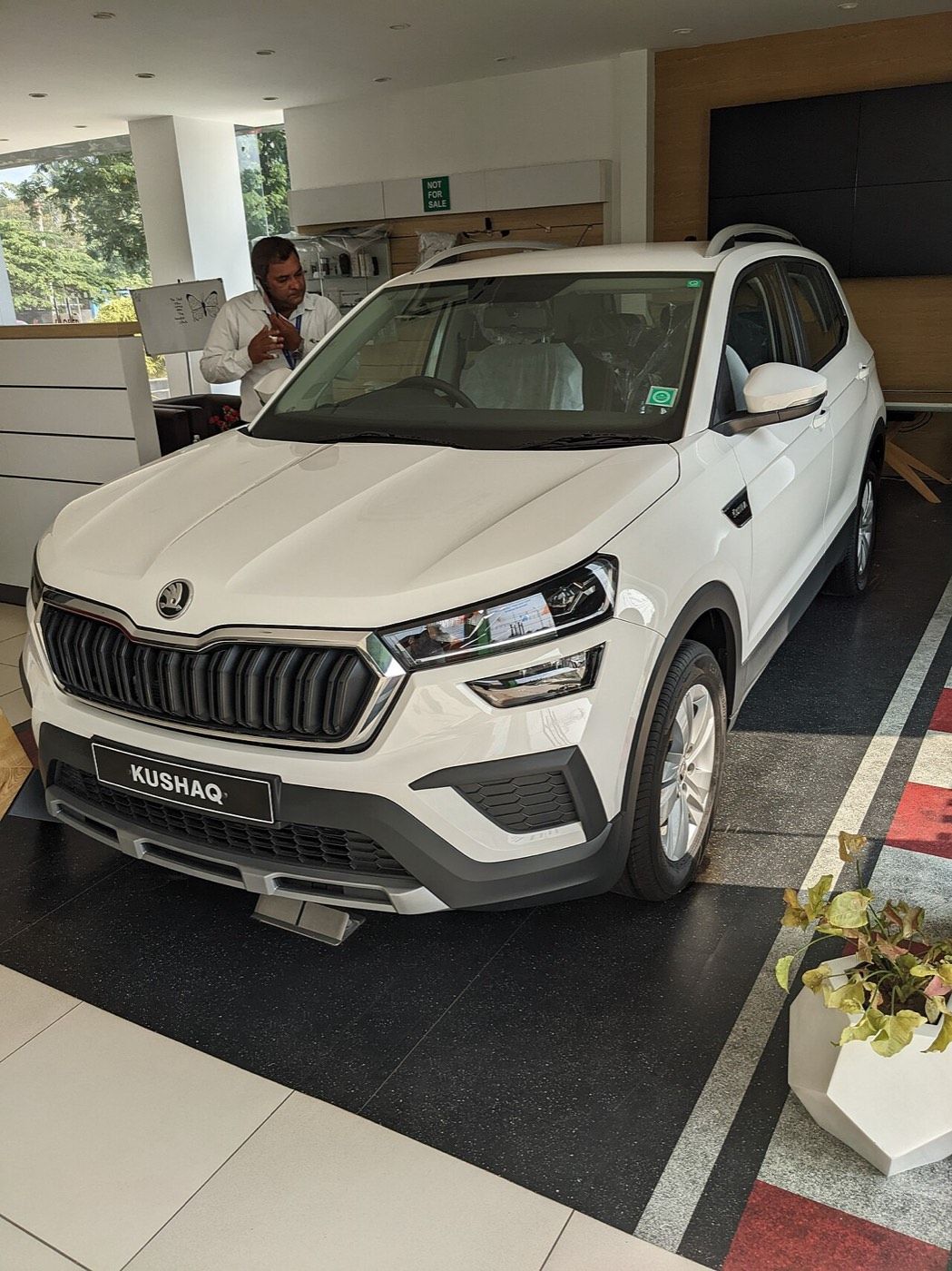
The cabin is solid, sensible and slightly boring. The 10-inch touchscreen responds properly, the digital cockpit on Style and above is the class’s best for legibility, and every switch has a damped click that communicates the same message as the door thud. The dual-zone climate works, the cooled glovebox is a South-Asia-proven idea, and the panoramic option on the Monte Carlo at ₹17.79 lakh brings light into an otherwise grey-and-functional room. Materials are durable rather than warm: this is German functionalism at an Indian price, which means you respect the cabin more than you love it.
The lower trims are where the accountancy stings. The ₹12.50 lakh Ambition feels thinner-equipped than cars ₹2 lakh cheaper from Korea, and the value centre of gravity in this listing is unambiguously the Style tier.
Practicality: the 340-litre confession
The footprint promises and the boot itemises: 340 litres is the smallest cargo space of any SUV in this catalogue, a figure that falls out of the sedan-derived packaging and the structure’s crash engineering. A family that loads for weekends should physically test a week’s luggage and a stroller against the parcel-shelf geometry before signing; a couple that packs soft bags will never notice. The rear bench, to be fair, is one of the class’s better ones for two adults on a 2,651 mm wheelbase, with the third position the usual tall-person grievance.
Efficiency and the ownership ledger
Claimed 18 kmpl; MotoSutra estimates 11-13 kmpl in the city and 15-16 on the expressway. That is within a rounding error of the turbo-Koreans and a few kmpl ahead of nothing; the TSI earns its economy through tall gearing and momentum, which is to say it rewards the driving style the chassis already prefers. Service pricing at the VW group’s network is the quiet tax on the engineering: cheaper than the old import premium, dearer than the volume brands, and predictable.
Verdict
The Kushaq asks you to weight a purchase the way engineers do — structure, brakes, torque, highway composure — and those weights genuinely favour it. But it will not be bought around: the boot is small, the base trims are mean with equipment, and the automatic is a good-natured appliance rather than a DSG memory. Style MT if you drive; Style AT if you commute; Monte Carlo if the roof matters more than the mortgage. This is the one you buy after the spec-sheet shopping is over, and the one you stop shopping after.
Who should buy it
Highway-heavy families and sedan-minded buyers who want altitude without abandoning composure; anyone whose test-drive checklist includes a brake pedal’s initial travel. Who should not: boot-first shoppers, equipment-maximalists on a ₹12 lakh ceiling, and drivers who take a torque converter’s politeness personally.
Pros and cons
What we like
- A five-star GNCAP adult score with six airbags, stability control and all-wheel disc brakes standard on even the ₹10.34 lakh base car
- The 1.0 TSI’s 175 Nm plateau from 1,750 rpm makes it feel two engine sizes bigger around town and honest on a ghat road
- Highway composure at 100-130 km/h is the class reference: flat-riding, quiet, and the car sits there like a sedan with altitude
- The MQB-A0-IN structure and door-close thud are the real product; everything else is packaging
What we would change
- 340 litres of boot is the smallest of the SUVs in this catalogue, and the footprint will not tell you so
- The automatic is a conventional torque converter — competent, but slower than the dual-clutch memory the badge carries
- Lower trims are equipment-poor for the money; the features worth having start at the Style tier
- The ride is firm over sharp cross-road bumps, and the cabin is trimmed like a tool rather than a lounge
Frequently asked questions
What is the real-world mileage of the Kushaq?
The claimed figure is 18 kmpl. MotoSutra estimates 11-13 kmpl in mixed Delhi traffic and 15-16 kmpl on an expressway leg at 100-110 km/h — a realistic-use band that sits below the claim, as a tall-geared turbo generally does.
Is the Kushaq boot really that small?
It is 340 litres with the bench up — the smallest of the SUVs listed here — behind a 4,300 mm body that suggests larger. It takes two cabin bags and a fortnight of shopping, and wants the seat folded for a stroller-plus-luggage airport run. Check it against your actual load list before booking.
Which Kushaq variant should I buy?
The Active MT at ₹10.34 lakh is the safety-value pick: six airbags, ESC and four-disc brakes come with it regardless of trim. But the Style MT at ₹14.50 lakh adds the digital cockpit, cruise and the equipment a car this well engineered deserves, and the Style AT at ₹15.99 lakh is the right city configuration.
How does the automatic compare to the old dual-clutch?
The six-speed torque converter in this listing is smoother at walking pace and slower in a kick-down than the DSG enthusiasts remember. It suits the car’s temperament — the Kushaq is a cruising machine, not a point-to-point one — but drivers expecting dual-clutch snap should take the manual.