Bike review
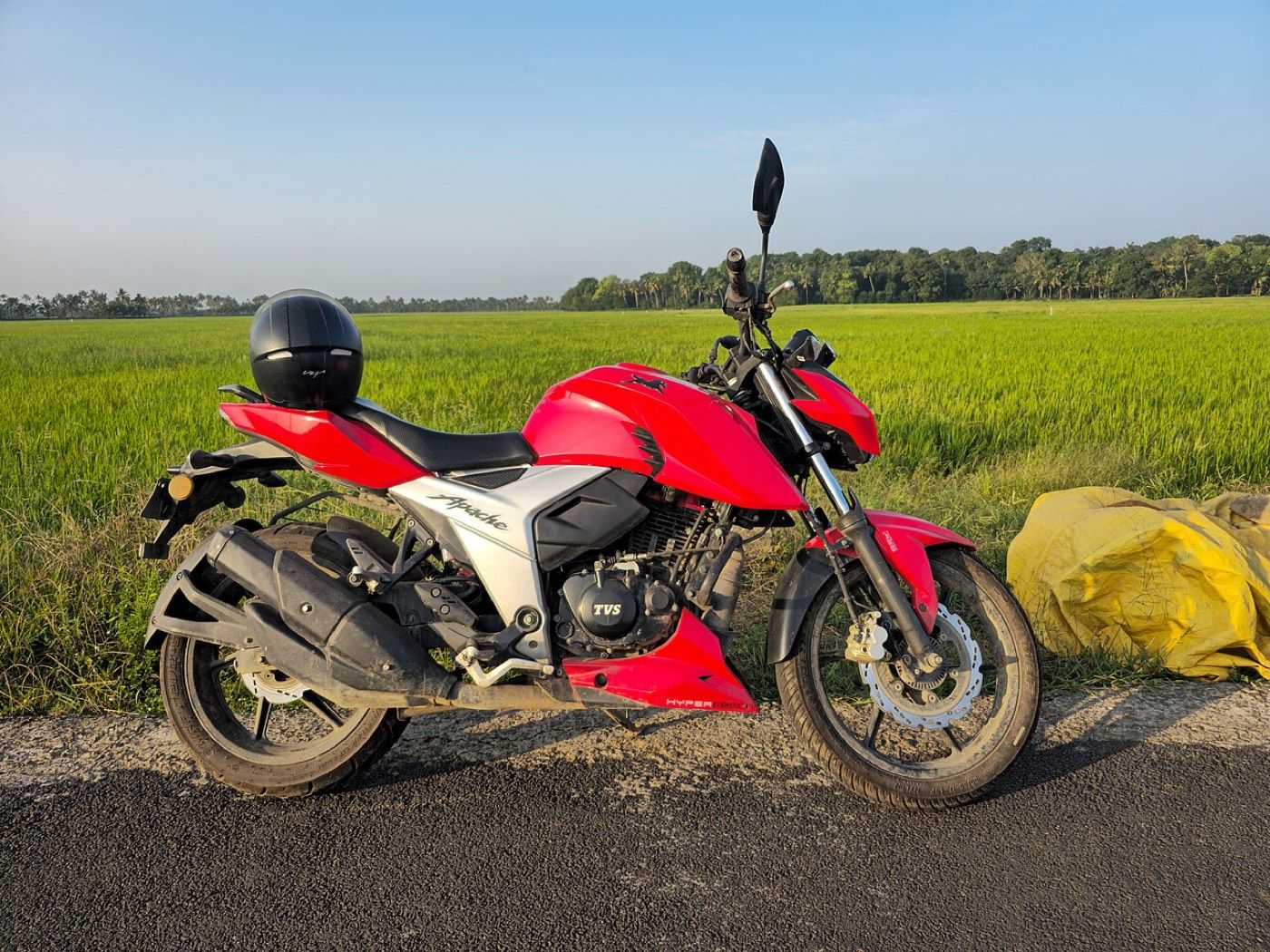
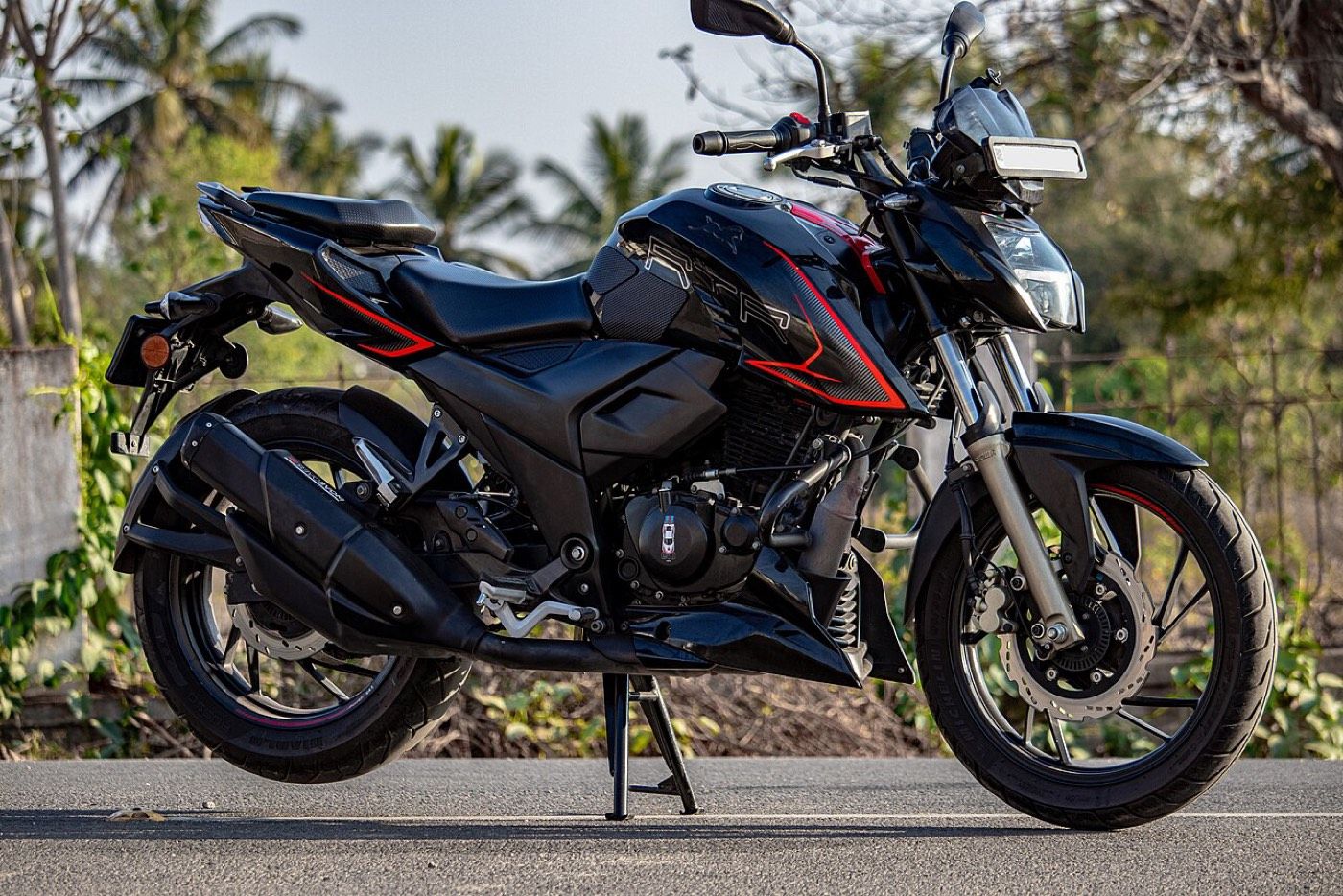
TVS Apache RTR 200 4V review: the 200 that behaves like one and refuses to sound like one
20.9 bhp, 153 kg, three ride modes and the best exhaust note in the class — the RTR 200 4V is the do-everything quarter-litre, provided you accept that its claimed 45 kmpl and its telescopic fork are both telling you a polite version of the truth.
- TVS Apache RTR 200 4V ₹1.39L
MotoSutra editorial rating
4.2/5
Verdict
The RTR 200 4V is the most complete one-bike answer in the 200s in this catalogue: quick enough to be fun, relaxed enough to be a commuter, clever enough to teach a beginner throttle control through rain mapping. Buy the ₹1.47 lakh Sport for the Bluetooth console and dual-channel ABS peace of mind; the ₹1.50 lakh Sport Edition adds the slipper clutch and sliders if you plan to ride it the way the exhaust note invites. The base bike at ₹1.39 lakh exists, but keeps the rear drum, and that is the one compromise this review declines to call sensible.
MotoSutra has not physically tested this vehicle. This review is research-based editorial analysis of the documented specification and published material; the score is a MotoSutra editorial rating. Read how we review.
The cleverest thing about the current Apache RTR 200 4V is that TVS resisted making it better. The temptation of the 200cc class is to chase the number — twenty-five horses, a sharper bar, some aero theatre — and hand the commuter segment to someone else. Instead this bike has been refined toward completeness: a motor with a torque plateau wide enough to hide gear changes, three personalities selectable from the bar, and ergonomics that let the same motorcycle belong to a college third-year and a forty-year-old weekend-er. MotoSutra has not ridden the Sport Edition, the ₹1.50 lakh top step on its unverified catalogue; what follows is a research-based reading of its specification against the mixed city-and-highway abuse its buyers describe.
Power, torque and the note that sells the bike
The 197cc four-valve single makes 20.9 bhp at 9,000 rpm and 18.1 Nm at 7,250, but the peaks are press-release numbers; the story is the band. The torque plateau sits between roughly 4,000 and 8,000 rpm, so on the ratio list the Apache should already be pulling low in the band and keep pulling smoothly to the top of it, and then make a noise — the source of a baritone bark under load that flatters the rider far out of proportion to the acceleration. And that is the honest formula of this bike: on paper it should feel faster than 20.9 bhp is entitled to, because the torque arrives exactly where traffic lives and the exhaust tells you a lie in a register you believe.
The listed 117 km/h is the useful truth rather than the terminal one: MotoSutra reads the gearing as confident between 70 and 100, able to overtake a city bus with a downshift and no ceremony, and settled into a 90-100 cruise with the single relaxed. Past that it works, loudly, for speed. The slipper-assisted clutch on the Sport Edition is meant to make downhill downshifts chirp instead of crash, and the five-speed box is light and, on the spec, hard to misuse.
Ride modes: the feature that earns its name
Sport, Urban, Rain, switched on the move through the ride-by-wire throttle. In a market where “modes” are often a map change measured in decimals, the Apache’s are documented as real throttle-map steps rather than rounding errors: Sport sharpens part-throttle response so the front wheel hears your intentions immediately; Urban is softened for pillion-and-mangoes commuting; Rain is the mapping designed to keep the back line honest on a wet morning, when a sudden second-gear opening would otherwise have been an event. How distinct they feel on the wrist is a test-ride question, but three genuinely different maps for ₹1.50 lakh is the strongest value proposition in the listing, and the lean-angle readout in Sport is the nerd-candy bonus.
Weight, ergonomics and the daily life
At 153 kg kerb with a low, flat saddle and upright bars, the RTR 200 reads as the easiest big-small bike to live with: balanced at standstills, flickable through gaps, neutral on the feet, and a pillion perch — firm and upright — that survives a market run. The knee grip on the tank, the wide mirrors and the legroom make it a two-hundred that a six-footer does not fight and a shorter rider can plant. Where the spec admits its price is the fork: telescopic, unadjustable, and the kind of unit that dives under hard braking — competent on paper, but the one chassis component a long-distance rider would notice first.
Mileage: the arithmetic that keeps buyers loyal
The claim is 45 kmpl and MotoSutra’s estimate of the real world is 38-43 on mixed commuting, dipping into the mid-30s when Sport is used as intended. With the 12-litre tank, that is a 450-500 km working range, which is the actual adventure feature of a commuter-class sports bike: a week of city riding between fills and no fuel anxiety on a weekend run. Efficiency at this end of the market is a feature list item, and the Apache spends its development budget accordingly — correctly, on the numbers, given the alternative is a firmer fork and a 40 kmpl claim nobody checks. For the buyer whose decision happens at the petrol pump rather than the spec sheet, that is the paragraph that closes the sale, and it is why the 200s remain the volume class of Indian motorcycling no matter what the launch calendars say.
Equipment and finish
The digital console lists gear position, shift-timing light and, on the Sport’s SmartXonnect Bluetooth, navigation mirroring and vehicle alerts on the phone — at this money, generous. Switchable ABS with a rear-off mode, hazard lamps on hard braking, and dual-channel stoppers from the ₹1.43 lakh variant up. The two honest deductions: the ₹1.39 lakh base still runs a rear drum, which is a cost decision this review declines to endorse; and the switchgear, levers and some paint edges are where TVS pays for the electronics, in the manner of every Japanese major doing the same trade. Interior and fit score 3.9 here for that reason.
Verdict
The RTR 200 4V is the 200 that behaves like one and refuses to sound like one — broad torque, usable electronics, real ride modes, commuter economics and ergonomics that include the pillion and the parent. Its two admissions of class are the fork under hard braking and the top-end effort past 110; everything else about it is a counter-argument to the costlier sports bikes two shelves up. Take the Sport at ₹1.47 lakh if the budget says stop, the Sport Edition at ₹1.50 lakh if you will use the slipper clutch, and the ₹1.39 lakh base only if rear drums are a hill you are willing to shop on. In this catalogue’s 200 band, there is no more complete single answer to a first real motorcycle.
Pros and cons
What we like
- Three ride modes through ride-by-wire that change the bike’s personality more honestly than the word "mode" usually promises — Sport is not a sticker
- The 18.1 Nm plateau from roughly 4,000 to 8,000 rpm makes junction pulls and 90 km/h overtakes effortless at the exact speeds Indian traffic lives at
- At 153 kg with upright bars and a flat floorboard-to-peg zone, it is the easiest 200 to live with daily and the easiest to learn fast on
- A real-world MotoSutra estimate of 38-43 from the 12-litre tank still means 450-plus km between pumps, even if the claimed 45 kmpl is optimistic
What we would change
- The plain telescopic fork dives under hard braking and the rear drum on the base variant at ₹1.39 lakh is a 2019 decision in a 2026 market
- The 117 km/h claim is best understood as a suggestion; past about 110 the single is shouting and the bike is cruising, not accelerating
- The seat is firm for a pillion and the rear is narrow relative to the bike’s sporting posture
- Fit-and-finish is good, not exceptional — switchgear and levers are where TVS recoups the feature-list budget
Frequently asked questions
What is the Apache RTR 200 4V price in this catalogue?
₹1.39 lakh for the base variant up to ₹1.50 lakh for the Sport Edition, ex-showroom Delhi NCR on MotoSutra’s unverified catalogue — four steps apart, with dual-channel ABS arriving at ₹1.43 lakh.
What mileage does the RTR 200 give?
The claim is 45 kmpl, which assumes Urban mode and a gentle wrist. MotoSutra estimates normal city riding at 38-43 kmpl, with the low-40s reachable on a steady commute and mid-30s when the bike is ridden in Sport the way it asks.
What do the ride modes actually change?
Throttle mapping through the ride-by-wire system. Sport sharpens response and unlocks the full band; Urban softens part-throttle for two-wheelers, grandmothers and wet paint; Rain limits torque delivery on slippery surfaces. The engine hardware does not change — the personality does, noticeably.
Is the RTR 200 4V a good first motorcycle?
It is arguably the best in this catalogue: the power band is broad rather than peaky, the chassis forgives late braking, and Rain mode is a training wheel a beginner can actually use. The low seat and 153 kg mean it does not intimidate at a standstill either.